!Ad Hook Vs Landing Page Hero Align Headlines Paid Search hero image
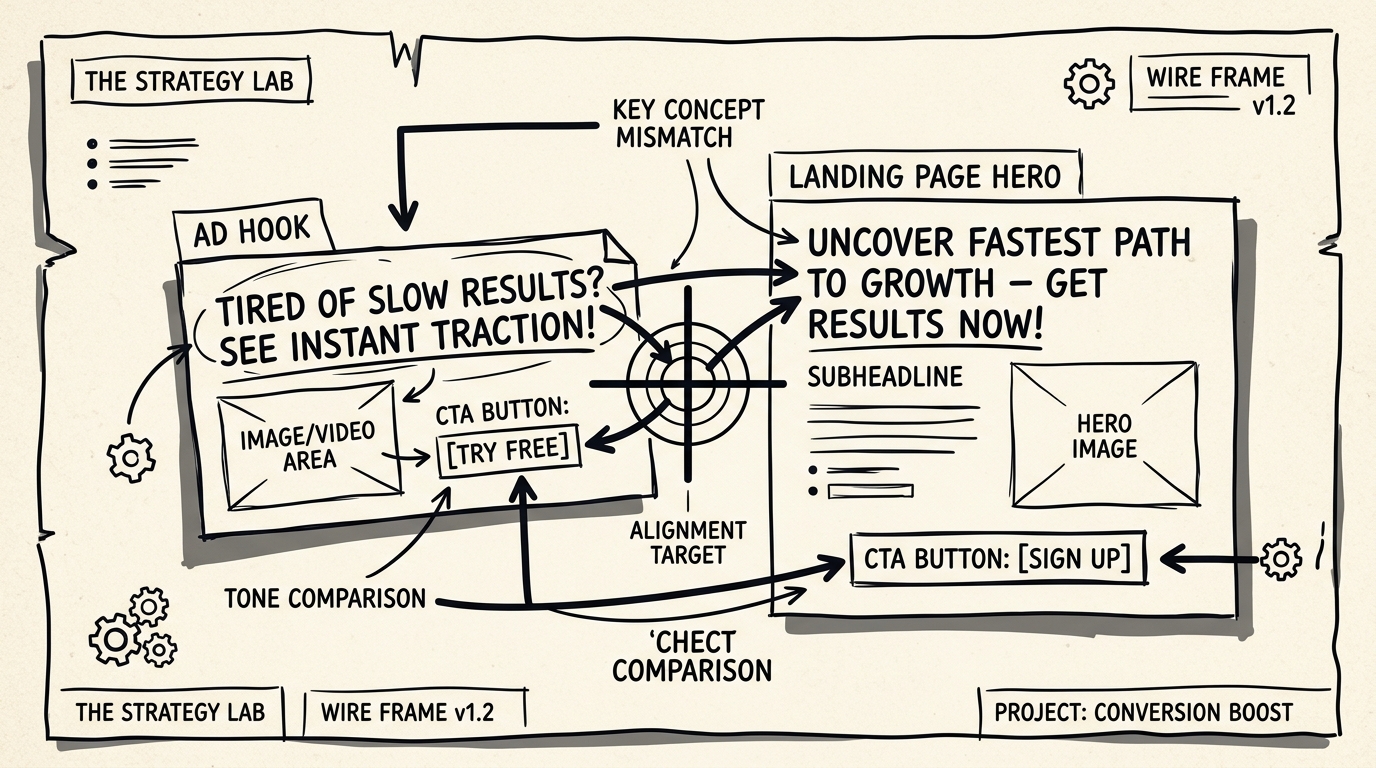
Ad Hook vs Landing Page Hero: How to Align Headlines for Paid Search
TL;DR: Your ad hook and landing page hero must be perfectly aligned to prevent bounces, but they don't always need to be identical word-for-word. The ad hook earns the click by making a specific promise, while the landing page hero validates that promise and expands on the value proposition.
The main difference between an ad hook and a landing page hero is their immediate goal: an ad hook's job is to capture attention and earn a click, whereas a landing page hero must validate that click, deliver on the promise, and initiate the conversion.
While they serve different immediate purposes, they are two sides of the same coin. This dynamic is the tactical execution of Google Ads landing page message match. The ad is the opening statement, and the hero is the immediate confirmation. If they are out of sync, traffic bounces.
Headline Alignment Rules for Paid Search
To maintain scent continuity, you must follow strict alignment rules between your ad copy and your landing page H1.
First, the core offer must be identical. If the ad says "Free Audit," the hero cannot say "Schedule a Consultation." Second, the primary benefit must remain the focal point. Third, the emotional tone (urgent, professional, casual) must carry through seamlessly.
The goal is to ensure the user feels they have arrived exactly where the ad told them they were going. As noted by Unbounce's conversion benchmark reports, strong message match can significantly lower your Cost Per Acquisition (CPA).
When Not to Mirror Verbatim
Should the LP headline match the ad word-for-word? Not always. Exact verbatim mirroring is sometimes necessary for highly specific transactional queries, but it can often feel robotic or miss an opportunity.
Google Ads have strict character limits. A landing page hero (H1 + subheadline) has more real estate. You should use that space to expand on the ad's promise. The H1 can strongly echo the ad's hook, while the subheadline adds the crucial context, social proof, or specific details that wouldn't fit in the ad copy. The Message Match Framework relies on this expansion of intent.
Successful Pattern Examples and Metrics
Consider an ad for B2B accounting software.
Ad Hook: Automate Your Agency Payroll in Minutes.
Landing Page Hero (H1): Automate Your Agency Payroll.
Landing Page Subheadline: Connect your timesheets and run payroll in under 5 minutes without manual data entry.
This pattern is highly effective. The core promise is identical, maintaining perfect scent continuity. However, the landing page uses its extra space to add specificity ("under 5 minutes", "without manual data entry") that validates the click and pulls the user deeper into the page.
Agencies deploying this exact pattern often see a 20-30% lift in conversion rates simply because the cognitive load on the user is reduced.
The Role of AI in Orchestrating Campaign Stories
For performance agencies, manually aligning hooks, funnels, and landing page copy across hundreds of ad groups is a massive operational bottleneck. This is where AI orchestration changes the game.
Instead of writing ads and landing pages in silos, modern agencies use AI agents to generate complete, end-to-end campaign stories. A centralized AI system understands the initial hook and automatically weaves that exact narrative through the ad copy, the landing page hero, and the entire UX flow, ensuring perfect message match without manual QA.
Common Headline Mistakes
The most common mistake is writing the ad and the landing page in isolation. When a media buyer writes a clever hook, but the design team creates a hero based on brand guidelines rather than the specific campaign, message match is destroyed.
Another frequent error is using a clever, abstract headline on the landing page when the ad was direct and literal. If the ad is literal, the hero must be literal.
FAQ
Should the LP headline match the ad?
Yes, the landing page headline should strongly match the ad to maintain scent continuity. It doesn't need to be a 1:1 identical copy, but the core offer and primary benefit must remain exactly the same.
Do ad headlines have to be exact match?
Ad headlines do not have to be an exact verbatim match to the landing page H1, but the primary benefit, tone, and specific offer must be perfectly aligned to prevent immediate bounces.
How do I write a landing page hero?
Write a landing page hero by directly referencing the Google Ad that drives traffic to it. Ensure your H1 validates the ad's promise immediately, and use the subheadline to expand on the value with specifics or social proof.
What happens if my ad hook is different?
If your ad hook is significantly different from your landing page hero, users will experience cognitive dissonance and bounce immediately. This results in wasted ad spend, lower Quality Scores, and poor conversion rates.
How do you maintain scent continuity?
Maintain scent continuity by designing the ad and the landing page as a single, unified campaign story. Ensure the vocabulary, core offer, and visual elements remain consistent from the initial click to the final conversion.
Conclusion
Aligning your ad hook with your landing page hero is a tactical necessity for profitable paid search. While they don't always need to be carbon copies, the intent and promise must be perfectly synchronized.
For agencies handling multiple clients, ensuring this alignment across hundreds of ads and pages is difficult without a dedicated system. If you need a better way to produce campaign stories that guarantee message match before implementation, leveraging AI orchestration to build end-to-end narratives is the most effective solution.
Further Reading
- Learn more about Google Ads Best Practices
- Read CXL's Guide on Landing Page Optimization